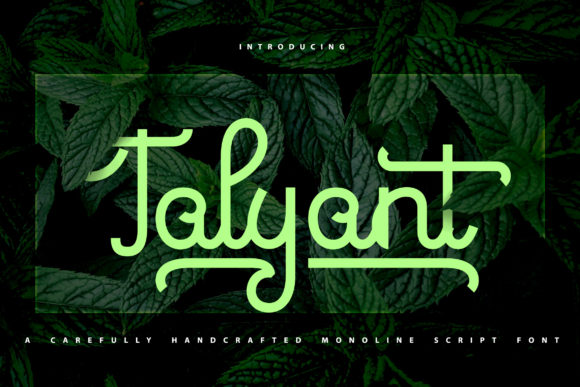
Talyant: A Handmade Script Font for Authentic Branding
It started with a blank brand board—and a quiet café client who said, “I want people to feel like they’ve stepped into my grandmother’s kitchen: warm, intentional, and quietly special.” No mood boards yet. Just that feeling. So I opened my fonts folder, scrolled past the sleek sans serifs and polished serifs, and landed on Talyant. Not because it was trendy—but because Talyant is a handmade script font with unique characters and an authentic feel. And right then, before a single mockup existed, I knew this Script Handwritten typeface would shape the tone of the whole identity.
Talyant for Wedding Invitations and Elegant Branding
I tested Talyant first on wedding-style stationery—not for a real couple, but as a quick litmus test. Why? Because if a Script Handwritten font can carry emotional weight in something as delicate as an invitation, it’ll hold up in branding where subtlety matters. I typed “The Daily Grind Café” in Talyant over cream linen paper—soft contrast, no harsh edges. The letters flow like ink just pulled from a nib: slight variation in stroke weight, gentle entry/exit swashes, and those thoughtful alternates that make every word feel hand-lettered, not templated. That’s the magic of Talyant: it doesn’t shout—it invites. For clients leaning into craft, heritage, or slow-living aesthetics, Talyant isn’t just a font choice. It’s a tonal anchor.
Talyant on Business Cards and Branded Packaging
Next came the business card. Small format. High touch. Real-world legibility test. I set the café’s name in Talyant at 14pt on matte kraft stock—no background, no shadow. At arm’s length? Perfectly readable. Up close? You notice the subtle texture in the curves—the way the lowercase “g” curls just slightly more than the “a,” how the capital “D” has that confident, tapered flourish. This isn’t a monoline script. It’s alive. As a Script Handwritten font, Talyant thrives in short-form applications: product labels, jar stickers, menu headers, even chalkboard-style social posts. But don’t force it into paragraphs. It’s a display font—best used for names, taglines, quotes, and hero moments. Think of it as your brand’s signature, not its voiceover.
Talyant for Greeting Cards and Social Media Graphics
I built a simple Instagram carousel: three frames—morning light on coffee beans, a handwritten quote (“Good things take time”), and a seasonal special. For the quote slide, I layered Talyant over a soft-focus background. Instant warmth. Instant pause. That’s what makes Talyant such a strong choice among Fonts for creatives who design greeting cards, boutique packaging, or artisanal web banners. Its rhythm slows the scroll. Its authenticity builds trust. And because it’s a true Script Handwritten typeface—not a digitized imitation—it avoids the uncanny valley of “almost-handmade” fonts. You can tell it was drawn, not generated.
Talyant in Logo Design and Brand Identity Systems
Here’s where I got cautious—and honest with myself. Talyant is gorgeous, but it’s not a standalone logo system. It needs balance. So I paired it with a clean, warm serif (think: a slightly softened Playfair Display) for body copy, menus, and website text. Talyant became the hero—the café name on the awning, the “Est. 2023” stamp on the bag, the “Thank You” on the receipt. That pairing works because Talyant brings soul; the serif brings structure. As a Script Handwritten font, Talyant excels when used intentionally—not everywhere, but where emotion lives. It’s not about replacing typography hierarchy. It’s about elevating it.
Talyant for Posters, Quotes, and Printed Marketing Materials
I printed a 16×20 poster: “Brewed Slow. Served Warm.” in Talyant, centered on off-white cotton rag. No embellishment. Just spacing, weight, and presence. In person, the ink spread slightly into the fibers—enhancing the handmade illusion. That’s why Talyant shines in physical media: posters, flyers, gallery wall prints, even embroidered patches (when converted to vector outlines). It’s designed for tactility. As one of the most expressive Fonts in the Script Handwritten category, Talyant rewards thoughtful sizing and generous line height. Don’t cram it. Let it breathe. Let it feel like something made—not selected.
Talyant for Brand Consistency Across Digital and Print
Final check: Does Talyant hold up across platforms? Yes—but with nuance. On screen, I used it only above 24px for headlines and hero sections. Below that, readability dips—not because of poor hinting, but by design. Talyant is meant for impact, not utility. For email headers, Instagram story text, or website banners, it performs beautifully. For body copy on a Shopify product page? Pair it wisely. Also worth noting: the font includes standard OpenType features—ligatures, stylistic alternates, and contextual swashes—so you’re not stuck with default letterforms. That flexibility lets you fine-tune tone per use case without switching fonts.
Talyant as a Commercial Font for Client Projects
This is the part I tell every freelancer: Talyant is licensed for commercial use—meaning you can use it in client work, sell branded merchandise, and embed it in digital templates (with proper licensing review). No surprises. No hidden limits. As a Script Handwritten font built for real designers, it ships in OTF and WOFF formats, supports Latin-based languages, and includes both uppercase and lowercase glyphs with thoughtful punctuation. If you’re sourcing Fonts for small businesses, makers, studios, or local brands, Talyant delivers premium quality without premium friction. It’s not flashy. It’s faithful—to craft, to character, to the quiet confidence of handmade design.