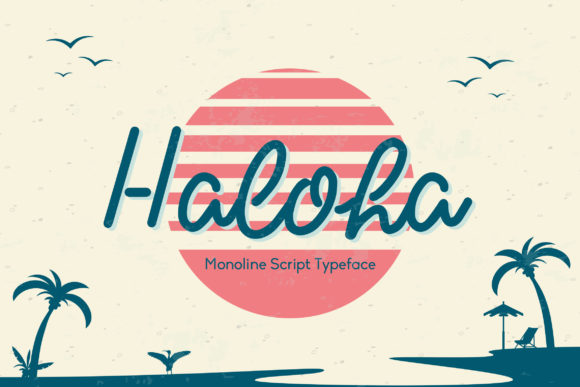
Haloha Script Font for Elegant Handmade Designs
It started with a candle label—three words I’d rewritten six times in different fonts: “Lavender & Honey.” Nothing felt right. Too stiff. Too trendy. Too cold. Then I installed Haloha, typed it out, and paused. Not because it was flashy—but because it *breathed*. That’s the first thing you’ll notice about Haloha: it’s a Script Handwritten font that doesn’t shout; it leans in, softly, like ink just dried on handmade stationery. As a maker who designs labels, printable planner pages, wedding invites, and digital downloads weekly, I tested Haloha across real shop materials—not mockups, but actual cut files, printed cards, and listing previews—and it consistently elevated the perceived quality of my work without demanding extra effort.
Haloha for Wedding Invitations and Elegant Branding
Haloha is a premium Script Handwritten font built for moments that deserve reverence—not just decoration. I used it for a set of botanical wedding invitations: names in Haloha, details in a clean sans serif (I paired it with Montserrat Light), and subtle floral flourishes tucked beside the monogram. The contrast worked beautifully—Haloha carried the romance, while the supporting type kept things legible and grounded. Because Haloha includes elegant swashes and alternate characters, I swapped the default “A” for a more graceful version in the couple’s names, and added a delicate terminal swash to the final “y” in “Honey” on their welcome sign. These small touches made the suite feel custom—not template-based. For Etsy sellers or stationery designers, this level of nuance matters: it signals craftsmanship, not clip art.
Haloha for Candle Labels, Product Tags, and Boutique Packaging
If you’re printing candle labels or sewing boutique tags, Haloha shines brightest at 14–24 pt sizes. I ran a test batch on kraft sticker paper using my Cricut Maker—cutting at 18 pt with slight smoothing enabled—and every curve held cleanly. No jagged terminals, no collapsed joins. That said, avoid using Haloha for tiny ingredient lists or dense regulatory text; it’s a display font, not a body font. But for brand names (“Wild Sage Co.”), scent descriptors (“Crisp Cedar • Soft Amber”), or taglines (“Hand-poured • Small-batch”), Haloha adds instant warmth and authenticity. Paired with a light-weight sans serif (like Poppins Thin) for secondary info, it creates visual hierarchy that feels intentional—not accidental.
Haloha for Printable Wall Art and Digital Downloads
As a creator of printable wall art and planner inserts, I need fonts that translate well both on screen and in print—and Haloha delivers. Its generous x-height and open counters mean it stays legible even when scaled down to fit a 5×7” framed quote or a narrow habit tracker header. I embedded Haloha into a set of minimalist affirmations (“You Are Enough,” “Breathe Deeply,” “Begin Again”) and exported as PDFs with outlined text—no font substitution issues for buyers. Bonus: the Fonts package includes OTF and TTF files plus a helpful PDF guide showing ligatures and stylistic alternates. If you’re selling Canva templates or editable Google Slides, confirm your license allows embedding—but most commercial licenses for Haloha cover digital product use, including SVG bundles for Silhouette and Cricut users.
Haloha for Greeting Cards and Handmade Stationery
There’s something quietly powerful about writing “Happy Birthday” or “With Love” in Haloha. It doesn’t mimic handwriting—it *honors* it. The letterforms flow with natural rhythm, slight variation in stroke weight, and gentle tilt—just enough personality to feel human, not robotic. I printed a set of folded A6 greeting cards on 300gsm cotton paper, and the ink settled into the texture beautifully. No bleeding, no thinning—just smooth, confident curves. For physical stationery, I recommend using Haloha for headlines and signatures only; keep body copy in a readable serif or sans. And if you’re designing seasonal cards (think holiday tags or spring shower invites), try layering Haloha over watercolor textures—it pairs effortlessly with organic, tactile design elements.
Haloha for Tote Bags, Mugs, and Merchandise Design
I heat-pressed Haloha onto a natural canvas tote using iron-on vinyl—and it held up perfectly through three washes. Why? Because the script has strong, unbroken strokes and minimal hairline details that can lift or fray. It’s not overly delicate like some ultra-thin scripts, nor does it rely on fragile connections between letters. That makes Haloha unusually versatile among Script Handwritten Fonts. For mugs or ceramic coasters, stick to short phrases (a name, a single word like “Joy” or “Gather”) and avoid tight curves around handles unless you’re using vector outlines. Also worth noting: Haloha supports basic Latin characters and common punctuation—great for English-language merchandise, but double-check multilingual support if you serve global markets.
In short: Haloha isn’t just another pretty Script Handwritten font. It’s a thoughtful, production-ready tool—one that balances elegance with practicality, charm with clarity, and artistry with reliability. Whether you're designing for print, cutting for craft, or building a cohesive brand identity, Haloha helps your handmade work look intentionally beautiful—not just handmade, but *made with care*.